

Kirsten Twelbeck
Foundations: a Glimpse into our new Format
During the first two semesters of the IDK we set the tone of the program in our 5 “Foundations” classes on “Environment,” “Transformation,” “Inter- and Transdisciplinarity,” “Environmental Justice,” and “Narrative and Communication.” Alternately taught at both locations and by PI teams representing two different disciplines, they help PhD students recognize their own disciplinary grounding while expanding their understanding of other fields represented in the IDK. Ideally, this makes future conversations a lot easier! What a Human Geographer means when addressing “transformation” differs quite a bit from, say, a philosopher’s understanding of the term.

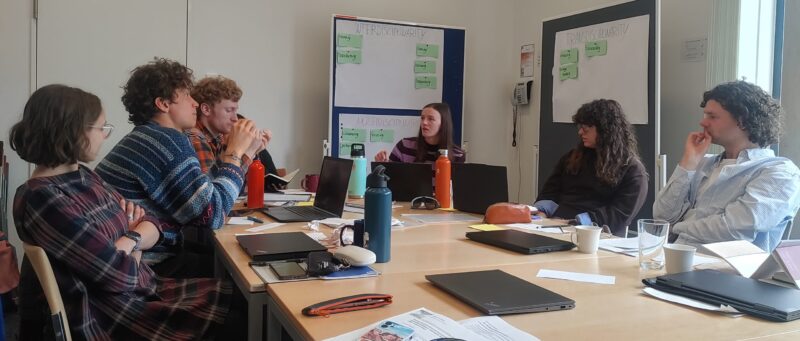
The class you see here was the one on Inter- and Transdisciplinarity, taught by Kirsten Twelbeck (American Studies) and Simone M. Müller (Environmental History) . They decided to address the topic in a more experimental, and experiential way: for three hours in a row, PhD students were engaged in various discussion formats that allowed them to grasp the complexity of the topic, explore their own positionality, and voice their enthusiasm, doubt and critique of inter- and transdisciplinary approaches. The workshop started with tandems where each partner merely listened to the other’s viewpoint and continued with various flipchart exercises including a SWOT analysis that was completed over the entire course of the event.


Mike Bal’s “travelling concepts” and Jesse Petersen’s inter/transdisciplinary research through an underwater 360° video poem spurred a lively discussion about the chances and risks of inter-and transdisciplinary research, which is just how it is supposed to be in a multi-voiced setting like the IDK. In the end, we had to skip the part where we wanted to explore differences and commonalities with the help of personal objects that the PhD students had been asked to bring along. But the discussion has only just begun and will be continued soon—Kate Rigby’s Masterclass on transdisciplinary research with affected communities and non-academic knowledge-holders (June) being the next great opportunity!
Written by Kirsten Twelbeck