


Review: Green Hour: “Sea Shepherd, Greenpeace, and… Moby-Dick?: Nineteenth-Century Anti-Whaling Sentiment at Sea and on Land” (Harrison Croft)
May 7, 2026
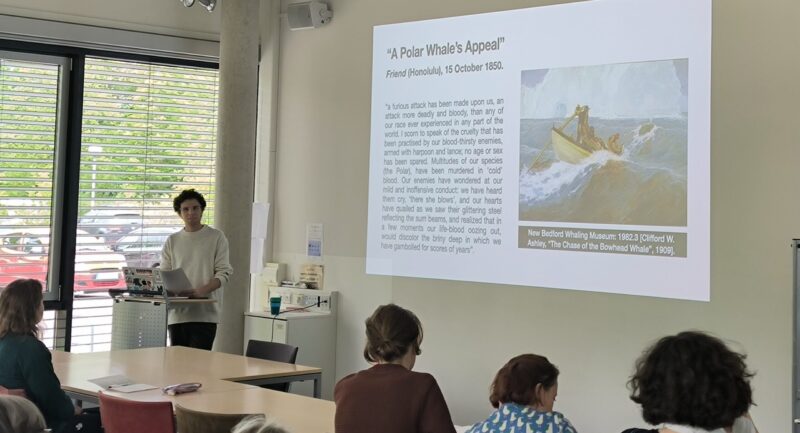
Concern for the survival of whales is not confined to the twenty‑first century. As early as the beginning of the twentieth century, environmental advocates in Japan were campaigning against whaling. But what, one may ask, was the situation in the nineteenth century? Can we already speak of an anti‑whaling movement at that stage? These questions were at the heart of Harrison Croft’s Green Hour lecture. Taking the United States as its point of departure, the talk zoomed in on Herman Melville’s Moby-Dick to find out what the novel had to say about the decline in whale populations that had started a few years earlier. Melville, it turned out, was part of a larger cultural discourse that emerged due to the sharp decline in whale populations between 1840 and 1870 and was eagerly taken up by the press. The debate was shaped above all by economic considerations. Whalers, ship captains, and investors alike grew anxious about their livelihoods as oil yields diminished. How, then, should such concerns be interpreted? Did their calls for stricter regulation mark the inception of a protest movement that persists to this day? Or ought their campaigns to be clearly distinguished from modern forms of protest that are driven by ethical, environmental, and spiritual concerns?
Written by Kirsten Twelbeck