


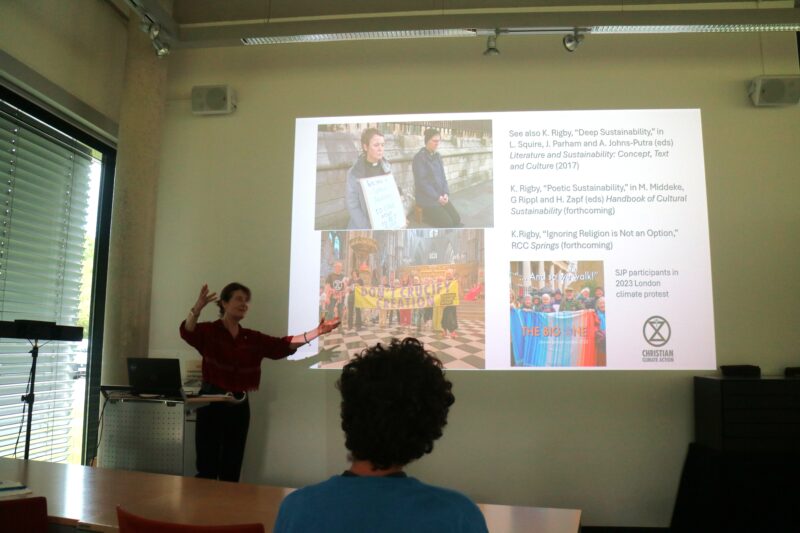

Despite subsistent calls for a transformation to globally sustainable development, humanity witnesses a glaring gap between explicitly defined sustainability goals and actions taken. How do scholars from the humanities and social sciences make sense of this ongoing—and widening–disconnect? And what can they contribute to enabling speedy action?
According to IDK guest professor Kate Rigby the problem is largely cultural. If we want to alter the situation, we must question the normative claims that forego a great deal of current research and policies: instead of creating a balance between environment, equity, and economy, the biophysical limits of the Earth must be recognized as setting boundaries within which social and economic goals can be achieved. And to be successful, new models of sustainability must urgently shift from narrowly defined human concerns to including non-human species from the very beginning: concepts like the “rights of nature” and personhood status for rivers signal what it means if humans understand of life-giving as a mutual process.
Working towards deep sustainability happens on many levels and in many local and regional contexts. Religious communities like the London-based “Daily Bread” project are particularly promising because they can rely on existing structures and cultural traditions to build trust and a (bio)diverse community.
Written by Kirsten Twelbeck