


Review: Field Workshop “Asphalted Planet”
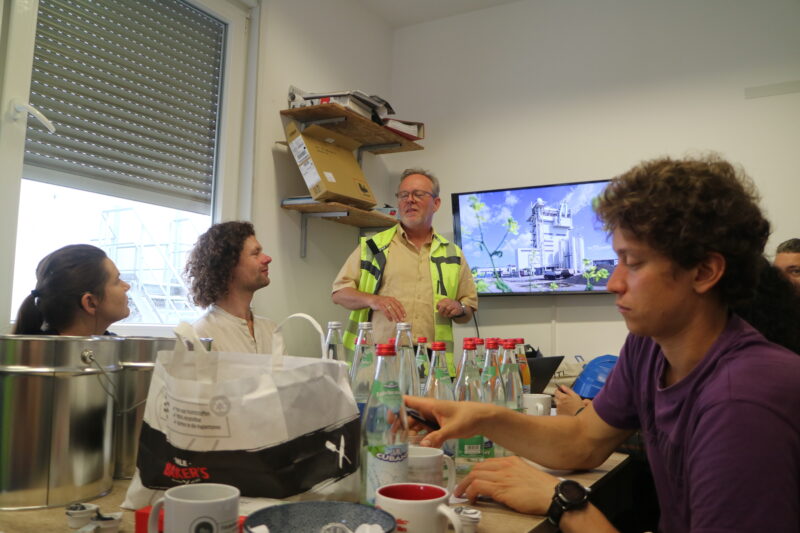
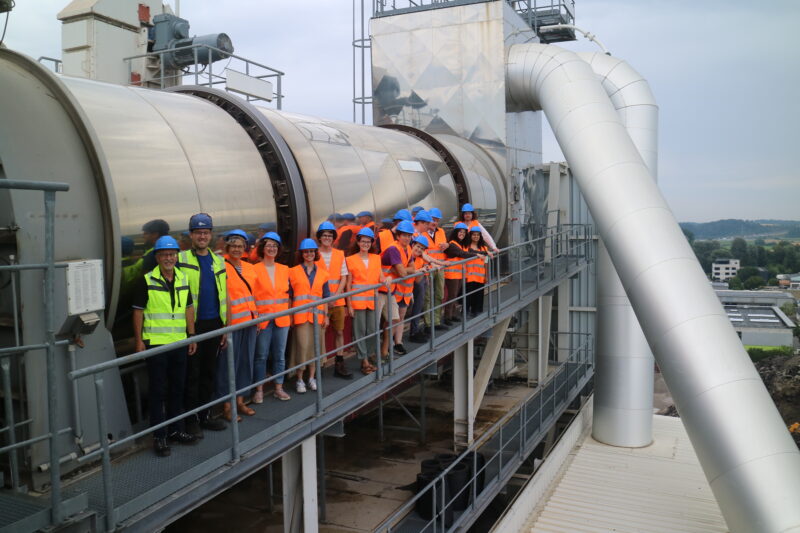
Our field workshops explore environmental issues from a regional, artistic, and various academic perspectives. Our first one dealt with asphalt—a composite substance marked by a profound ambiguity: on the one hand it has come to stand as symbol for societal progress, mobility, and the freedom of being “on the road;” on the other hand it is perceived as symbol of soulless modernity, deviant behavior, and – more recently – one of the main reasons for urban heat and malfunctioning water absorption. Reason enough, in other words, to take a close look at the material and its cultural text(s). After learning, from „Stoffgeschichten“ expert Jens Soentgen, about the origins and chemistry of asphalt we visited the asphalt mixing plant in the eastern part of Augsburg. Together with colleagues, the plant’s director, Alfred König, gave an amazing tour of the technical facilities high above the ground and explained about asphalt as a material that—contrary to the majority of mixed materials—can be (and is) recycled in full.
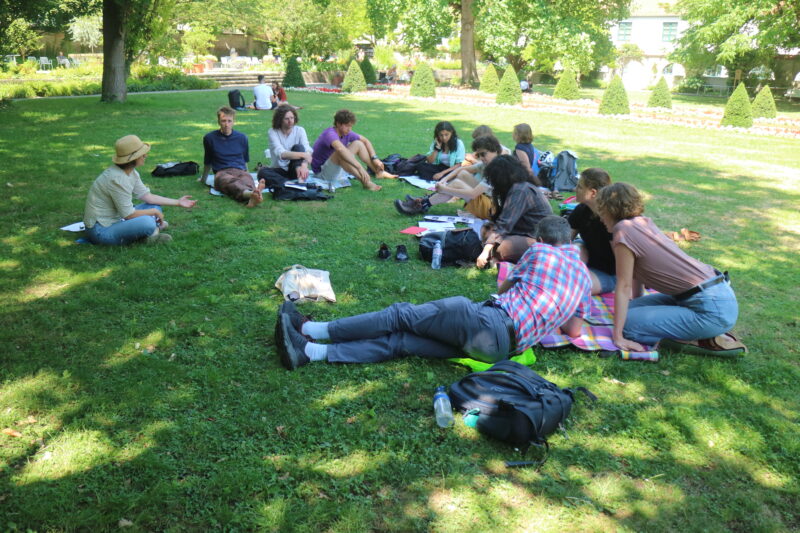
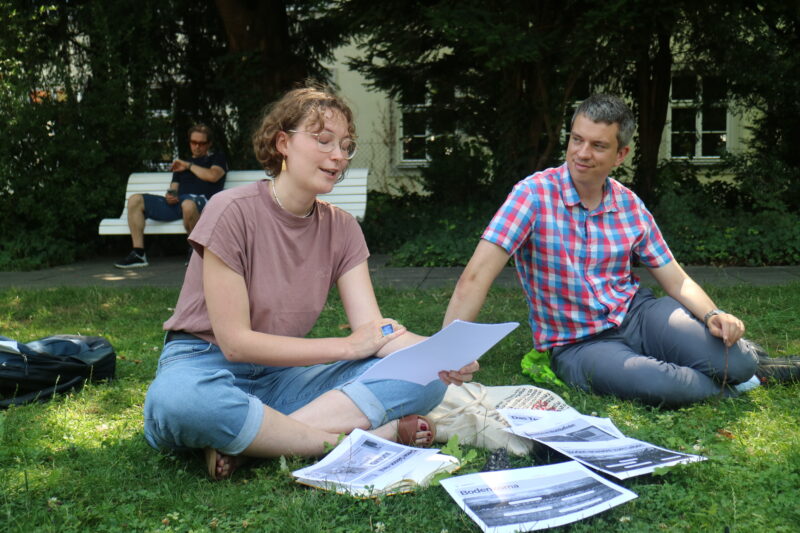
How, then, can asphalt be a problem? After their visit of the impressive yet also slightly intimidating asphalt mixing plant, the group gathered on the lawn of the lush “Hofgarten” park in the old center of Augsburg. Environmental historian Simone Müller presented a survey of global asphalt usage to discuss how postcolonial developmental action and the collapse of Communist Eastern Europe led to a rapid increase of asphalt usage on a global scale. Literary and cultural studies scholar Kirsten Twelbeck took up the topic by returning to the film viewing (focusing on Joe May’s “Asphalt” from 1929) from the previous day to discuss how asphalt became a symbol of a threatening yet fascinating modernity, a symbol for crime and female promiscuity, and a code for German antisemitism.
Among the experts who spent the day with the group was Daniel Vollprecht, professor of Resource and Engineering at Augsburg University. He not only inspired the conversation in the asphalt mixing plant with important and unexpected questions (and a deep knowledge of special terms) but helped the group continue that conversation by diving more deeply into the complex realities of asphalt recycling. After realizing that soil sealing increases despite 100% recycling rates, the group learned from IDK guest Lioba Huss (HfGG Koblenz) about “abpflastern”—a very successful research and activist initiative that supports city populations in Germany in “de-sealing” unnecessary asphalted surfaces, in cooperation with city administrations.
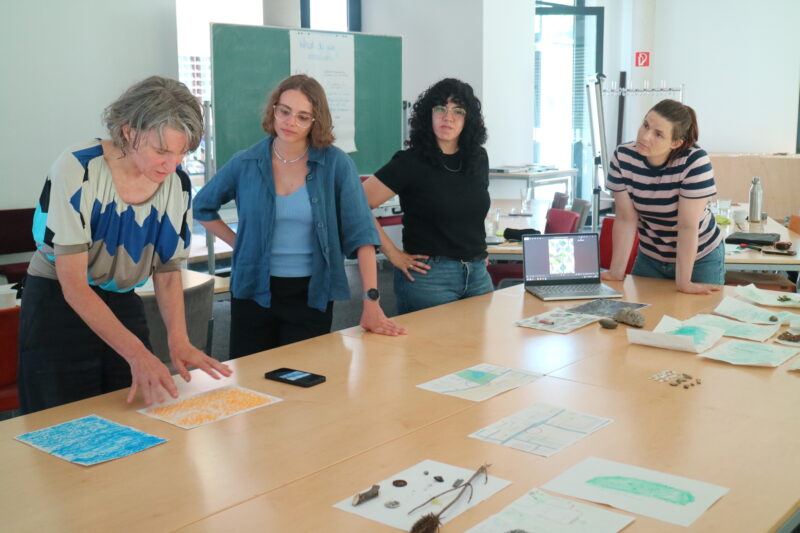
How do we relate to asphalt? Where do we see it? How does it feel, sound, smell, how is it used, and who owns it? Artist Folke Köbberling started her workshop by asking PhD students to answer such questions. This time, the method was based on experience and exploration: PhD students were asked to visit various sites on or near the Augsburg campus, taking with them a measuring tape, a pencil, wax crayons, paper for frottages. The exercise was a perfect introduction to art as an investigative approach to the complexity of asphalt, and its close relative, the car. How can art help us find a more sustainable relationship with this odd couple? How can we regain control over the “wild” vehicles that push and pull, squeeze and overhaul weaker objects and beings by a metal force associated with Germany? For artist Folke Köbberling, questions like these are the starting point for the creation of critical, but also surprising and somewhat humorous artworks in the public realm. In “automanic,” a performative sculpture she created with Martin Kaltwasser and David Moises, remote-control cars destroy a plasterboard car park. In “Mash&&Heal,” cars made of a special kind of clay block the view on a Munich square while plants, animals, and human dwellers slowly take possession of them.
written by Kirsten Twelbeck