


Julia Petersen
Review: Schneefernerhaus 2026

Johanna Eckert
A Special Atmosphere
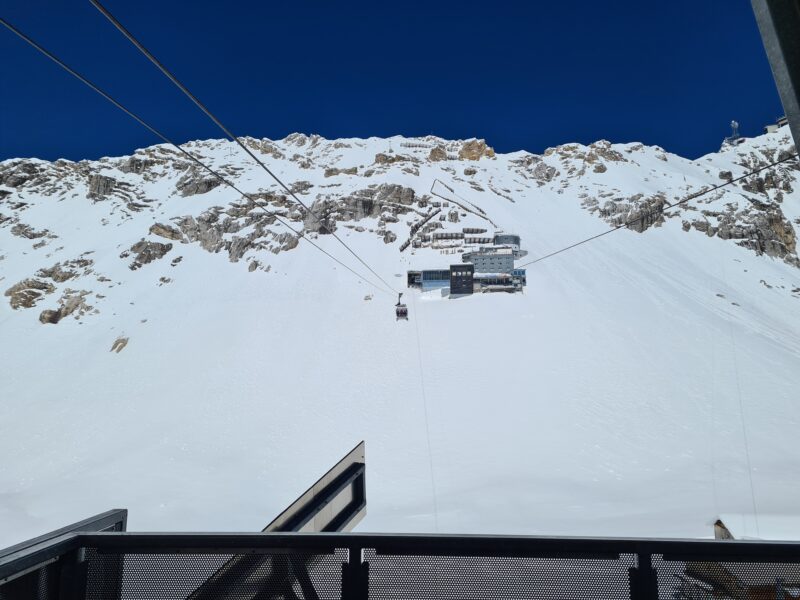
The Schneefernerhaus, which officially opened as a hotel in the early 1930s, now serves as a research station for studying climate change, atmospheric processes, and their effects on the human body. As a modern-looking facility that was literally carved into the rock and is located near the summit of the Zugspitze, the Schneefernerhaus offers sweeping views of the Alpine landscape. It’s unique atmosphere sets the Schneefernerhaus apart from other conference locations and makes it an ideal setting for individual and collective investigations of what it means to be an academic in our complex, conflict-ridden world.
Sonja Dümpelmann
Academic Selfpositioning
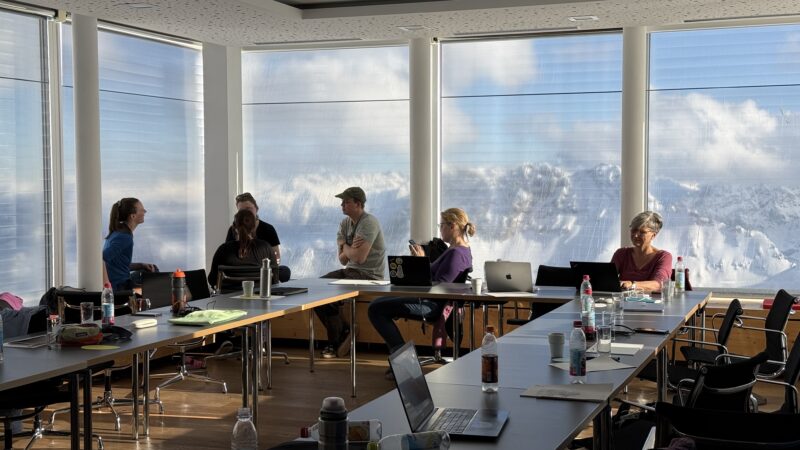
How can young researchers from the humanities and social sciences position themselves, as individual scholars and as members of an innovative research group, in the multi-, inter- and transdisciplinary landscape of contemporary academia? How can they thrive in the context of Environmental Humanities while maintaining their identification as individual scholars with roots in an “original” discipline? What does it mean to be a historian, a Latin American Studies scholar, an ethnographer, in the multi- and inter-disciplinary context of the IDK Rethinking Environment? Should we do away, altogether, with disciplinary boundaries? Or should we, rather, cultivate and refine our disciplinary identity to contribute more fruitfully to the interdisciplinary conversations that lie ahead? Can we, maybe, experiment with, and cultivate, new learning, listening, and discussion skills to enable intellectually inspiring conversations and cooperations that sustain us in an age of climate change, digitalization, and global conflict (to name just a few of the challenges that we must deal with)? Our IDK Softskills Workshops seek to meet the special needs of our PhD students who in most cases come from a traditional department context and are now thrown into the multi-disciplinary research setting of the IDK Rethinking Environment.
Kirsten Twelbeck
A Sense of Place
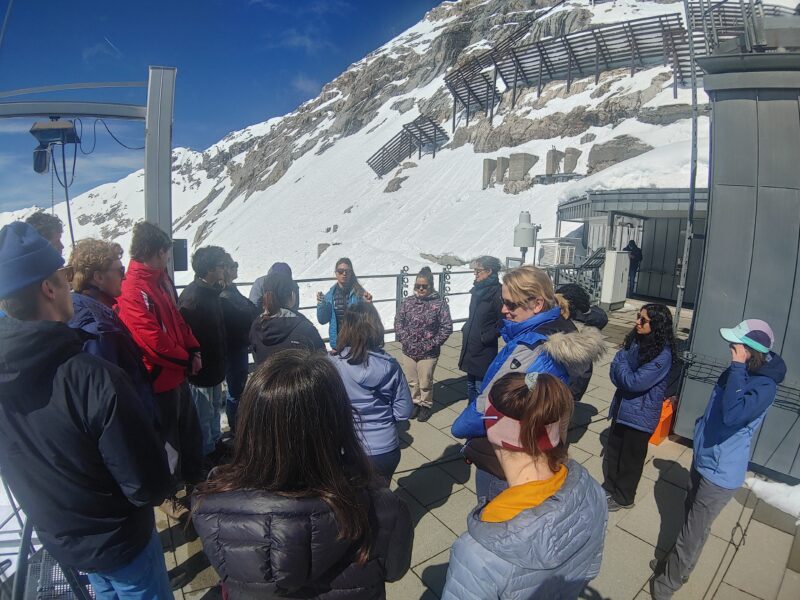
Living in an era of polycrisis has created a profound yearning for meaning and orientation. Where are we now, as a species? Which paths should we follow? Encouraging PhD students to pay attention to how they feel about a place, and be aware of what’s involved in getting there, is a surprisingly simple method to inspire conversations about sense of place and sense of time and the role of mobility as a prerequisite of modern lives. How do we make sense of the somewhat contradictory experience of using a combination of train, cog railway, and gondola to finally enjoy the privilege of learning in a seemingly secluded environment? Can a fuller understanding of our relationship to the world we live in help us solve the problems that come with modern lives? What can we learn from mountains? As we found out during our tour through the Schneefernerhaus (led by geographer Laura Schmidt), the Schneefernerhaus has many lessons to tell. Not only does it provide important data about climate change–it is also a connecting link between nations: as early as 1926, a tunnel (the so-called “Kammstollen”) was built to allow ski tourists from Austria to access the Hotel Schneefelder—today the tunnel, that is no longer open to the public, is used for documenting changes in the permafrost occurrence at the Zugspitze…
Networking
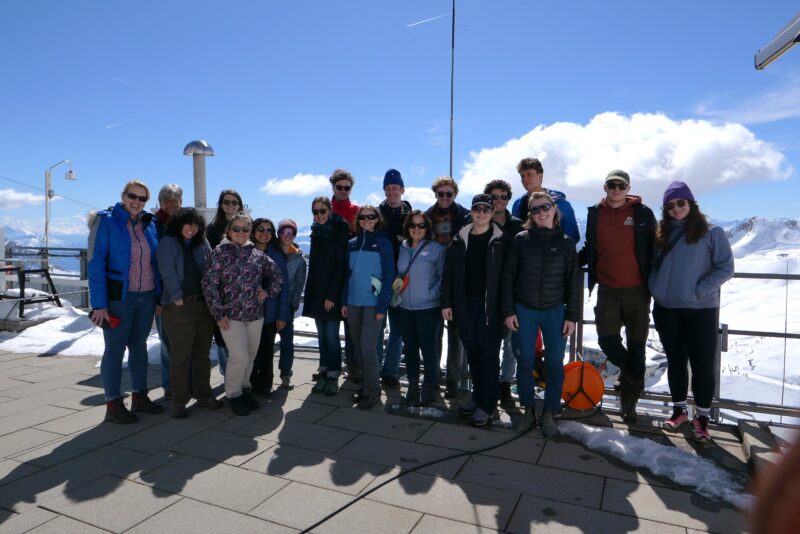
Networking and cross-generational communication is writ large in the IDK Rethinking Environment, and bringing together researchers from different career stages is a central aim of our program. During this workshop, the PhD students were joined by PIs Sonja Dümpelmann, Kerstin Schlögl-Flierl, and Kirsten Twelbeck, and by Maximilian Pieper, who studied with the IDK Rethinking Environment from 2021-2015. Max is now working alongside the new cohort as a postdoc – and his memories of being an early IDK PhD student still fresh on his mind make him a perfect source of information for the new cohort. ProEnviron scholar Jonas Danen joined the group from the RCC; he is in the late phase of the dissertation process and was able to contribute important advice from that perspective. Last not least, two international guests attended the workshop: the environmental historians Uluwehi Hopkins (University of Hawaii at Manoa, Hawaii) and Harrison Croft (Monash University, Australia). The two Humboldt Fellows work with Simone M. Müller at the University of Augsburg and gladly shared their experiences and advise with the new cohort.